
No products in the cart.

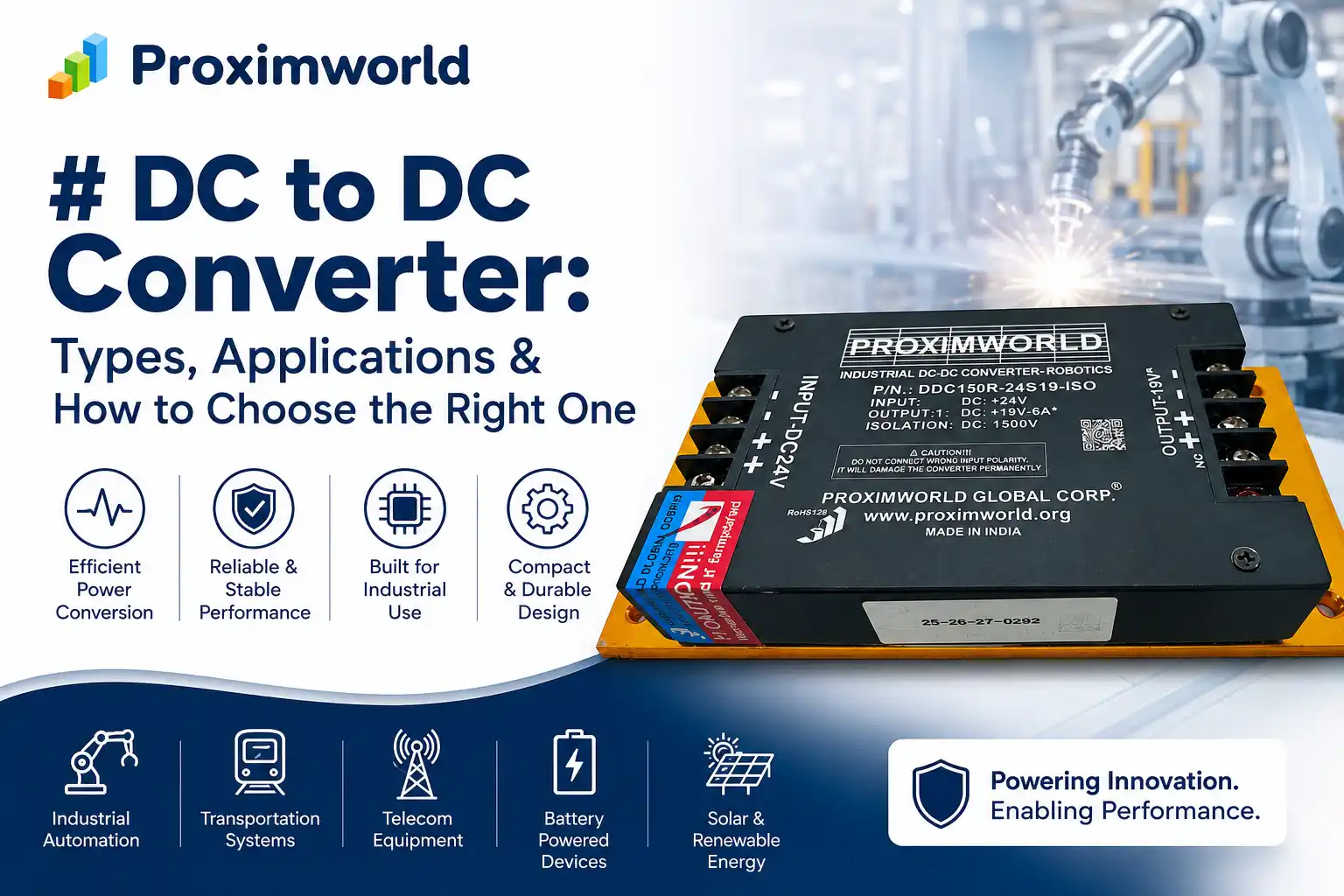
Selecting the right DC to DC converter is a critical design decision that directly impacts the stability, efficiency, and safety of industrial control panels and automation systems. A poorly matched converter can introduce electrical noise, cause intermittent sensor errors, or lead to premature component failure under thermal stress. In heavy-duty applications—such as telecom cabinets, railway systems, or factory floors—a properly specified converter ensures clean power distribution, handles battery voltage fluctuations, and isolates sensitive circuits from ground loops. Sizing and selecting the right unit upfront prevents costly troubleshooting, system resets, and unplanned production downtime.
Modern industrial systems rarely run on a single DC voltage. For instance, a control panel might need 24V for its PLC, 12V for sensors, and 5V for communication modules — all from one incoming DC bus. To address this, a DC to DC converter takes one DC voltage level and converts it cleanly to another, without the losses, noise, or instability that come from improvised workarounds.
Indeed, choosing the wrong converter doesn’t just waste power — it can also destabilize an entire control system, cause intermittent faults that are painful to diagnose, or shorten the life of expensive downstream equipment. Consequently, this guide breaks down what a DC-DC converter does, the different types available, and the ten factors that matter most when selecting one for industrial power conversion, automation, or control system applications.
A DC to DC converter is an electronic circuit that converts a direct current input at one voltage into a direct current output at a different, regulated voltage. Unlike an AC-DC power supply, however, it never touches the AC mains. Instead, it works entirely within the DC domain, typically taking power from a battery, an existing DC bus, or the output of an upstream power supply.
Most industrial DC-DC converters use switch-mode topology. Specifically, a transistor switches the input DC on and off at high frequency, and an inductor or transformer stores and releases energy during each cycle. Meanwhile, a feedback loop constantly compares the output to a reference and adjusts the switching duty cycle. As a result, it holds the output voltage steady even as input voltage or load current changes.
There are three broad categories worth knowing before you specify a DC-DC converter:

Reduces a higher input voltage to a lower, regulated output — for example, 48V down to 24V. Common where a central DC bus feeds lower-voltage devices.

Raises a lower input voltage to a higher output — for example, boosting a 12V battery rail to 24V for equipment that requires it.

Uses a transformer to electrically separate input and output circuits, protecting equipment from ground loops, voltage spikes, and safety faults — essential in many industrial and medical settings.
In a control panel, a well-selected industrial DC to DC converter means every downstream device gets clean, stable power regardless of what’s happening upstream. Furthermore, this matters most in systems that already run on battery or DC-bus architecture, such as railway rolling stock, telecom cabinets, or renewable energy installations.
For example, some of the most frequently specified conversions in industrial settings include 48V to 24V (telecom and railway backbones feeding automation devices), 48V to 12V (powering instrumentation and sensors from a higher battery bus — see ProximWorld’s 48VDC to 12VDC converter), and 24V to 12V (stepping down a standard automation bus voltage for legacy or lower-voltage components, as in the 24VDC to 12VDC converter).
Since a DC-DC converter sits directly in the power path of your control system, selecting the wrong one has consequences well beyond the unit itself. First, system reliability depends on stable voltage delivery, because even brief dips or spikes can reset a PLC or corrupt a communication bus. Additionally, power requirements must be sized correctly, since a converter running near its limit continuously runs hotter and fails sooner.
Moreover, efficiency and thermal management are closely linked: a low-efficiency converter wastes more input power as heat, which subsequently raises panel temperature and stresses neighboring components. At the same time, equipment protection features guard against the voltage transients and current faults that are common on industrial DC buses. Finally, because many installations run in harsh operating environments — including vibration, dust, humidity, or wide temperature swings — the converter’s build quality directly determines long-term industrial performance and total cost of ownership.
Therefore, here is exactly how to choose a DC to DC converter that performs reliably under real industrial conditions, not just on paper.
A DC to DC converter for PLC systems is only one of many roles these units play. To illustrate, common DC to DC converter applications include:

Stepping a central DC bus down to the exact 24V or 12V rails required by controllers and I/O modules, with tight regulation. ProximWorld’s DC to DC converter range covers this need across multiple power classes.

Powering distributed sensors and actuators from a shared bus while isolating noise-sensitive circuits from motor drives.

Converting -48V DC plant power down to the voltages needed by switching and networking equipment, with high reliability demands.

Handling wide input transients from onboard battery systems while meeting strict vibration and isolation standards.

Providing isolated, low-leakage DC rails for patient-adjacent devices where safety isolation is non-negotiable.

Regulating variable battery or panel voltage down to stable levels for monitoring and control electronics.

Converting battery bus voltage to the precise charge voltage required by secondary battery banks or backup systems.

Distributing multiple regulated voltage rails across SCADA nodes, drives, and instrumentation from a single DC source.
⚠ Choosing the wrong input voltage rangeSpecifying a converter around a nominal voltage while ignoring the real fluctuation range of a battery-fed or unregulated bus.
⚠ Undersizing the power ratingSizing for today’s load only, consequently leaving no margin for future panel expansion or added devices.
⚠ Ignoring startup or peak currentOverlooking inrush current from relays, solenoids, or motor-adjacent loads that consequently exceed steady-state draw.
⚠ Selecting insufficient efficiencyChoosing a lower-efficiency unit that therefore generates excess heat in an already thermally constrained enclosure.
⚠ Ignoring operating temperatureInstalling a converter rated for mild conditions inside a hot, poorly ventilated cabinet without first checking derating data.
⚠ Overlooking protection featuresSkipping short-circuit or overvoltage protection to save cost, thus risking cascading damage across the DC bus.
⚠ Choosing the wrong mounting configurationSelecting a form factor that doesn’t fit panel layout conventions, subsequently complicating future maintenance and replacement.
⚠ Ignoring isolation requirementsUsing a non-isolated converter in a circuit when it requires galvanic isolation for safety or noise-immunity reasons.
⚠ Ignoring the actual application environmentFailing to account for vibration, humidity, or dust exposure, even though typical-use conditions on the datasheet don’t reflect them.
⚠ Focusing only on priceChoosing the cheapest option instead of weighing total system reliability, warranty terms, and lifetime cost.
This comparison shows how DC-DC converter requirements shift once you move from a small application to a full industrial deployment. Specifically, for higher-load panels, ProximWorld’s 250W Series and 500W Series converters extend the same regulation and protection standards to greater power capacity.
| Parameter | Small Applications | Industrial Applications |
|---|---|---|
| Input Voltage | Fixed, narrow range (e.g. 12V ±5%) | Wide range, tolerant of battery sag/surge (9–75V) |
| Output Voltage | Single fixed output | Tightly regulated, sometimes multi-output |
| Current | Low, under 2A typical | Higher, with startup current headroom |
| Power | Under 25W | 25W to several hundred watts, panel-dependent |
| Protection | Basic overcurrent only | Short-circuit, overvoltage, over-temp, isolation |
| Cooling | Passive, no airflow needed | Convection or forced-air, derated by temperature |
| Efficiency | 75–85% | 90%+, optimized switch-mode topology |
| Reliability | Consumer-grade, shorter service life | Industrial-grade, MTBF-rated for continuous duty |
Read the full datasheet, not just the headline specsCheck derating curves, ripple figures, and transient response — not just the top-line voltage and current numbers.
Size for continuous load with real marginBase sizing on measured or calculated continuous load plus a genuine margin for startup and future expansion.
Confirm thermal conditions upfrontKnow your enclosure’s worst-case internal temperature before selecting a converter, not after installation.
Prioritize protection over priceA unit with robust short-circuit and overvoltage protection prevents far more expensive downstream failures.
Verify certifications with test reportsAsk for documentation behind CE, UL, or RoHS marks rather than accepting a printed label at face value.
Plan installation and wiring in advanceConfirm mounting orientation, terminal access, and clearance requirements fit your panel layout before ordering.
Choose a supplier with proven reliabilityLook for manufacturers with a track record in industrial deployments, not just consumer electronics.
Ask about customization optionsCustom voltage rails, connectors, or enclosure ratings can solve application-specific problems standard units can’t.
Check after-sales technical supportDirect access to engineering support speeds up troubleshooting and reduces downtime if issues arise in the field.
In conclusion, choosing the right DC to DC converter comes down to matching voltage requirements, power capacity, efficiency, protection features, operating conditions, and application-specific demands to your system — rather than simply picking the unit with the lowest price. Ultimately, a converter selected this way delivers stable performance and long-term industrial reliability, whereas a mismatched one becomes a recurring source of downtime.
It’s an electronic device that converts direct current from one voltage level to another, regulated voltage, without going through the AC mains — commonly used to distribute multiple voltage rails across industrial control systems.
Match input voltage range, output voltage and current, power rating, efficiency, operating temperature, protection features, mounting type, certifications, and application-specific needs such as isolation to your system requirements.
Total your continuous load, add margin for startup or peak current from relays and solenoids, and select a unit rated comfortably above that calculated peak.
A step-down (buck) converter reduces a higher input voltage to a lower output, while a step-up (boost) converter raises a lower input voltage to a higher regulated output.
Factory automation, telecom, railway, medical equipment, renewable energy, battery charging systems, and industrial control panels all rely on them for stable multi-voltage power distribution.
Quality industrial units are typically rated for tens of thousands of hours of continuous operation, often translating to 5–10+ years depending on load and thermal conditions.
Short-circuit, overload, overvoltage, and over-temperature protection are considered essential baseline features, along with isolation where safety or noise immunity is required.
Yes, provided it’s housed in a suitably rated enclosure or specifically designed for outdoor use with a wider temperature range and protective coating.
Aim for 90% or higher in modern industrial designs to minimize heat generation and reduce thermal stress in enclosed panels.
A tightly regulated, DIN-rail mounted unit that steps a central DC bus down to a stable 24V with short-circuit and overvoltage protection is the standard choice for most PLC panels.

Leave a comment