
No products in the cart.

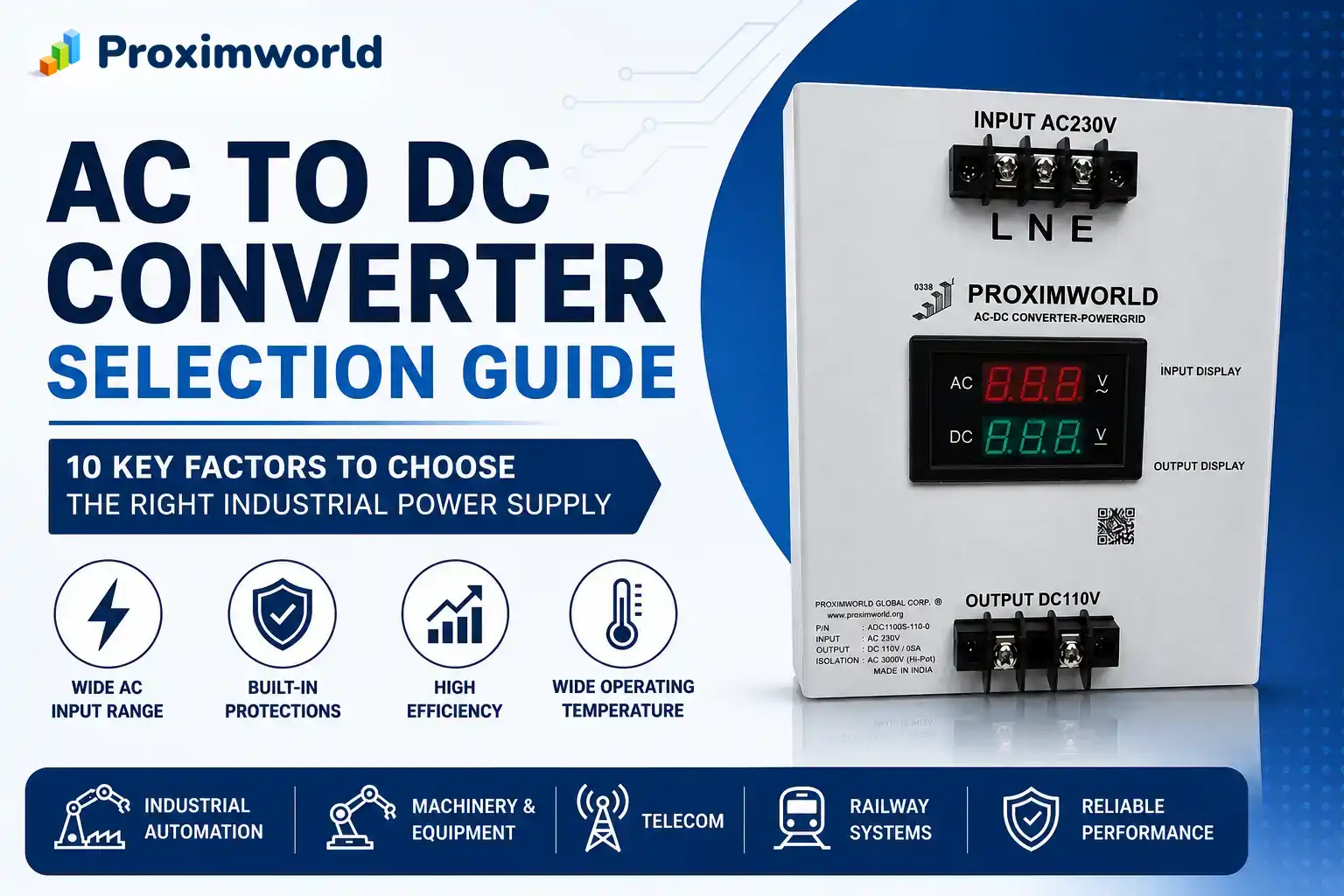
Every industrial control panel, automation line, and telecom cabinet depends on one quiet but critical component: a stable, well-matched power supply. Choosing the wrong one leads to nuisance trips, overheating, premature failure, and unplanned downtime that can cost far more than the unit itself. That’s exactly why engineers and procurement teams need a reliable AC to DC converter selection guide before they place an order.
This guide walks through what an AC to DC converter actually does, why correct selection matters on the factory floor, and the ten technical factors that separate a converter that lasts a decade from one that fails in the first monsoon season. Whether you’re specifying an industrial power supply for a new PLC panel or replacing an aging unit in a legacy system, this article gives you a practical framework you can apply immediately.
An AC to DC converter, also known as a rectifier-based power supply, is an electronic device that transforms alternating current (AC) from the mains grid into a stable, regulated direct current (DC) output. Industrial electronics, including PLCs, sensors, relays, HMIs, servo drives, and control circuits, run on DC voltage, so this conversion step is unavoidable in almost every automated system.
Inside a typical unit, incoming AC voltage first passes through an EMI filter to suppress electrical noise. A rectifier stage then converts the AC waveform into pulsating DC. This is smoothed by capacitors and, in switch-mode designs, chopped at high frequency through a switching transistor before passing through a transformer for isolation. A feedback control loop continuously monitors the output and adjusts switching to hold the DC voltage steady, even as input voltage or load current fluctuates.
In an industrial setting, an AC to DC converter is not a generic accessory — it is the foundation the entire control system stands on. A well-selected industrial AC to DC converter delivers clean, ripple-free DC power, tolerates voltage sags and surges common on factory grids, and keeps sensitive automation components protected from electrical disturbances that would otherwise cause erratic behavior or damage.
Picking a converter based on price or a rough voltage match alone is one of the most common causes of field failures. An undersized or poorly rated unit can overheat under real-world load, trip out during motor inrush events, or degrade faster in high-vibration or high-temperature environments.
The right selection process protects three things simultaneously: uptime, safety, and total cost of ownership. A correctly specified AC to DC power supply reduces unplanned maintenance visits, avoids cascading failures in connected equipment, and typically pays for any price premium many times over across its operating life. This is precisely why a structured AC to DC converter buying guide is worth following rather than relying on guesswork or a single datasheet number.
Here’s exactly how to choose an AC to DC converter that will perform reliably in real industrial conditions, not just on a datasheet.
1
Confirm the converter’s rated input range matches your local supply, and whether it needs to handle single-phase or three-phase mains. Facilities with unstable grids benefit from a wide input range (for example, 85–265V AC), which absorbs sags and surges without tripping the unit or triggering nuisance shutdowns.
2
Match the DC output precisely to what your downstream equipment expects — commonly 12V, 24V, or 48V for industrial control gear. Check the acceptable tolerance band too; sensitive PLC inputs and analog sensors can misbehave if the output drifts outside a narrow window under changing load.
3
Add up the continuous current draw of every connected device, then size the converter with headroom for inrush current from relays, solenoids, and motor starters. A common rule of thumb is to select a unit rated at least 20–25% above your calculated peak load.
4
Power rating (watts) should reflect total system demand across its full operating life, not just today’s load. Leave capacity for future panel expansion, additional sensors, or added I/O modules, since undersizing here is one of the most frequent causes of premature converter failure.
5
Higher efficiency (typically 85–95% in modern switch-mode units) means less power wasted as heat, lower electricity costs, and reduced thermal stress on internal components. For panels with limited ventilation, efficiency directly affects how long the converter and neighboring devices survive.
6
Check the converter’s rated ambient temperature range against your actual installation environment — inside a sealed panel, near furnaces, or in outdoor enclosures. Look for units with derating curves that clearly show how much output current is available at elevated temperatures.
7
Look for built-in short-circuit, overload, overvoltage, and over-temperature protection as a baseline. These features prevent a single fault from cascading into damaged downstream equipment and are especially important in panels where multiple devices share the same DC bus.
8
Decide between DIN rail, panel/chassis mount, or enclosed open-frame designs based on your panel layout and standard practice at your facility. DIN rail units simplify wiring and swap-out in control cabinets, while chassis-mount units suit larger fixed installations.
9
Verify relevant safety and quality certifications such as UL, CE, RoHS, and, where applicable, industry-specific marks for railway or hazardous-location use. Certifications aren’t paperwork alone — they confirm the unit has been independently tested against recognized safety and EMC standards.
10
Finally, match the converter to the specific demands of the application — vibration resistance for mobile equipment, conformal coating for humid or corrosive environments, or redundancy support for mission-critical systems that cannot tolerate any downtime.
An AC to DC converter for PLC systems is just one of many roles these units play across industry. Common AC to DC converter applications include:
PLC Panels
Powering controllers, I/O modules, and communication cards with stable 24V DC.
Factory Automation
Driving sensors, actuators, conveyor controls, and robotic cell electronics.
Telecom
Supplying backup-ready DC power to switching equipment and base stations.
Railway
Withstanding vibration and voltage transients in signaling and onboard systems.
Medical Equipment
Meeting strict isolation and leakage-current requirements for patient-adjacent devices.
Renewable Energy
Supporting monitoring, inverter control circuits, and auxiliary loads at solar and wind sites.
Battery Charging
Providing regulated DC for float and boost charging of backup battery banks.
Industrial Control Systems
Running SCADA nodes, drives, and instrumentation across process plants.
⚠ Undersizing the power supply
Selecting a converter based only on steady-state load and ignoring inrush current from motors, solenoids, and relays.
⚠ Ignoring ambient temperature
Installing a converter rated for office conditions inside a hot, poorly ventilated panel enclosure.
⚠ Overlooking certification requirements
Choosing an uncertified unit that later fails compliance audits or insurance inspections.
⚠ Choosing on price alone
A cheaper unit with weaker protection or lower efficiency often costs more in downtime and replacements.
⚠ Skipping future load planning
Sizing for today’s exact load leaves no headroom for panel expansion or added devices later.
⚠ Neglecting the manufacturer’s track record
Buying from an unverified source without checking warranty terms, support, or field reliability data.
This comparison highlights how requirements shift once you move from a small application to a full industrial deployment.
| Parameter | Small Applications | Industrial Applications |
|---|---|---|
| Input Voltage | Fixed, narrow range (e.g. 220V ±10%) | Wide range, single/three-phase (85–265V AC) |
| Output Voltage | Single fixed output (5V/12V) | Regulated 24V/48V with tight tolerance |
| Current | Low, 1–3A typical | Higher, with inrush headroom built in |
| Power | Under 60W | 100W to several kW, panel-dependent |
| Protection | Basic overload only | Short-circuit, overvoltage, over-temp, surge |
| Cooling | Passive, no airflow needed | Convection or forced-air, derated by temperature |
| Efficiency | 70–80% | 85–95%, high-efficiency switch-mode design |
| Reliability | Consumer-grade, shorter lifespan | Industrial-grade, MTBF-rated for continuous duty |
Verify real-world load, not nameplate values
Measure actual current draw where possible instead of relying only on component datasheets.
Ask for the derating curve
Request the temperature-vs-output-current chart, not just the maximum rated figure.
Check warranty and support terms
A longer warranty period is often a signal of manufacturer confidence in build quality.
Prioritize proven certifications
Confirm CE, UL, or RoHS marks are backed by test reports, not just printed on the label.
Plan for redundancy in critical systems
Consider parallel or N+1 configurations where downtime isn’t an acceptable risk.
Work with a manufacturer, not just a reseller
Direct access to engineering support speeds up troubleshooting and custom requirements.
Selecting the right industrial power supply isn’t about picking the unit with the highest wattage or the lowest price — it’s about matching input conditions, output needs, protection features, and environmental demands to your specific application. Working through this AC to DC converter selection guide before you specify a unit helps you avoid the downtime, safety risks, and hidden costs that come from a mismatched power supply.
ProximWorld’s engineering team can help you evaluate load requirements and match the right power supply for your panel or application.
It’s a device that converts alternating current from the mains supply into regulated direct current used to power industrial electronics like PLCs, sensors, and control circuits.
Match input voltage, output voltage and current, power rating, efficiency, temperature range, protection features, mounting type, certifications, and application-specific needs to your system requirements.
Calculate your total continuous load, add headroom for inrush current from motors or relays, then choose a unit rated around 20–25% above that peak figure.
The terms are often used interchangeably in industry. Technically, “converter” refers to the AC-to-DC conversion function, while “power supply” describes the complete packaged unit, including regulation and protection circuitry.
Factory automation, telecom, railway, medical equipment, renewable energy, battery charging systems, and industrial control panels all rely heavily on them.
Quality industrial units are typically rated for tens of thousands of hours of continuous operation, often translating to 5–10+ years depending on load and ambient conditions.
Short-circuit, overload, overvoltage, and over-temperature protection are considered essential baseline features for any industrial-grade unit.
Yes, provided it’s housed in a suitably rated enclosure (such as IP65 or higher) or specifically designed for outdoor use with wider temperature tolerance and conformal coating.
Aim for at least 85% efficiency in modern switch-mode designs to reduce heat generation and lower long-term energy costs, especially in enclosed panels.
A regulated 24V DC DIN-rail unit with tight voltage tolerance, short-circuit protection, and adequate current headroom is the standard choice for most PLC panels.

Leave a comment